

Malikappurathamma is the most important sub-deity worshipped within the Sabarimala temple tradition. Devotees who have offered prayers to Lord Ayyappa also pay their respects at Malikappuram, recognizing the Goddess as an integral presence in the sacred landscape of Sannidhanam.
She is worshipped as Bhagavathi, and Kerala Tourism also records traditions that identify her with Bhadrakali and Madurai Meenakshi. Around her are several overlapping legends, family memories and festival rituals. These should be approached as living sacred traditions rather than compressed into a single modern biography.
Who is Malikappurathamma?
In temple practice, Malikappurathamma is a Goddess with her own shrine and worship at Sabarimala. Kerala Tourism describes her as the principal sub-deity of the temple complex and says that pilgrims returning after worshipping Sri Dharma Shasta should also bow before her.
The name is commonly explained through malika, meaning a mansion or substantial residence. Malikappurathamma is thus “the Mother of Malikappuram,” associated with the mansion-like shrine and the sacred precinct surrounding it.
This practical identity is important. Malikappurathamma is not merely a character added to Ayyappa's story; she is a worshipped deity whose shrine, attendants and observances have a distinct place within Sabarimala.
The Mahishi tradition
One widely known legend begins with Mahishi, the powerful being whom Ayyappa was born to defeat. In the sacred narrative, Ayyappa—Hariharatmaja, the son of Shiva and Vishnu in the form of Mohini—fulfils his mission by overcoming Mahishi.
Kerala Tourism recounts a tradition in which Mahishi is released from her previous form, appears as a beautiful woman and expresses the wish to remain with Ayyappa at Sabarimala. She comes to be associated with Malikappurathamma. The story transforms conflict into liberation and proximity to the divine.
Popular retellings sometimes elaborate this episode with additional dialogue and promises. Details differ across regions and devotional communities. The shared core is her transformation and enduring place near Ayyappa, not every later narrative addition.
The Poonkodi and Cheerappanchira tradition
A second oral tradition connects Malikappurathamma with Poonkodi of the Cheerappanchira household in Alappuzha. Sabarimala lore remembers Cheerappanchira as the kalari where Ayyappa learned martial arts. In this account, Poonkodi, the kalari master's daughter, loved Ayyappa and later became associated with Malikappurathamma.
Kerala Tourism's history of Sabarimala records this as a belief held by devotees, not as an established historical identification. The distinction matters: the Poonkodi narrative preserves the sacred memory of a family and place, while the Mahishi narrative belongs to a mythic account of Ayyappa's divine mission.
The two traditions need not be forced into competition. Sacred landscapes often gather more than one story, with each explaining a different relationship among deity, devotee, family, place and ritual.
Malikappurathamma as Bhagavathi, Bhadrakali and Meenakshi
At Sabarimala, Malikappurathamma is worshipped as Bhagavathi—a broad and deeply rooted Kerala name for the Goddess. The Guruthi conducted in connection with Malikappuram is specifically described as an offering for Bhadrakali. Kerala Tourism also notes that she is worshipped as Madurai Meenakshi in relation to traditions connecting the Pandya dynasty and Pandalam.
These names are not necessarily competing labels. Hindu temple traditions often understand one divine feminine presence through several forms and regional histories. Bhagavathi identifies her as the Goddess; Bhadrakali expresses a powerful protective form; and Meenakshi connects the shrine with a wider dynastic and South Indian sacred memory.
Where is the Malikappuram shrine?
Malikappuram forms part of the Sabarimala sacred complex near the principal shrine of Lord Ayyappa. Pilgrims traditionally visit after their main darshan. The nearby Manimandapam becomes especially important during the Makaravilakku period and is associated with Kalamezhuthu, processions and Guruthi observances.
Visitors should follow current directional signs, queue arrangements and temple instructions. Crowd-control routes may change during the busiest days, so a remembered route or an old online diagram should not override on-site guidance.
Why devotees worship at Malikappuram after Ayyappa darshan
The visit expresses the completeness of Sabarimala worship. Lord Ayyappa is the presiding deity, but the pilgrimage landscape includes the Goddess, Ganapathi, the sacred steps, Manimandapam, forest deities and other associated presences. Paying respect at Malikappuram acknowledges that wider sacred order.
For pilgrims carrying the irumudi, this comes after the disciplined journey described in our guides to Mandalakalam and the 41-day vratham, Irumudi Kettu and Pathinettam Padi. The visit to Malikappurathamma is not an optional story stop; it is an act of reverence within the temple tradition.
Makaravilakku and the procession to Sharamkuthi
The Malikappuram precinct becomes the setting for significant observances during Makaravilakku. Kerala Tourism describes a five-day cycle of Kalamezhuthu at Manimandapam beginning with Makara Sankrama. Each day's coloured floor image presents a stage in Ayyappa's sacred life.
On the final day, Ezhunnallath—the ceremonial procession—reaches Sharamkuthi after the evening observances. The procession links Manimandapam, the eighteen sacred steps and Sharamkuthi in a ritual geography that remembers Ayyappa's story and the beings associated with the sacred hill.
This tradition is sometimes retold primarily through Malikappurathamma's personal longing. Official descriptions emphasize that the image carried in procession is associated with Ayyappa. Careful writing should preserve both the devotional stories people tell and the actual ritual subject described by temple sources.
Guruthi at Malikappuram
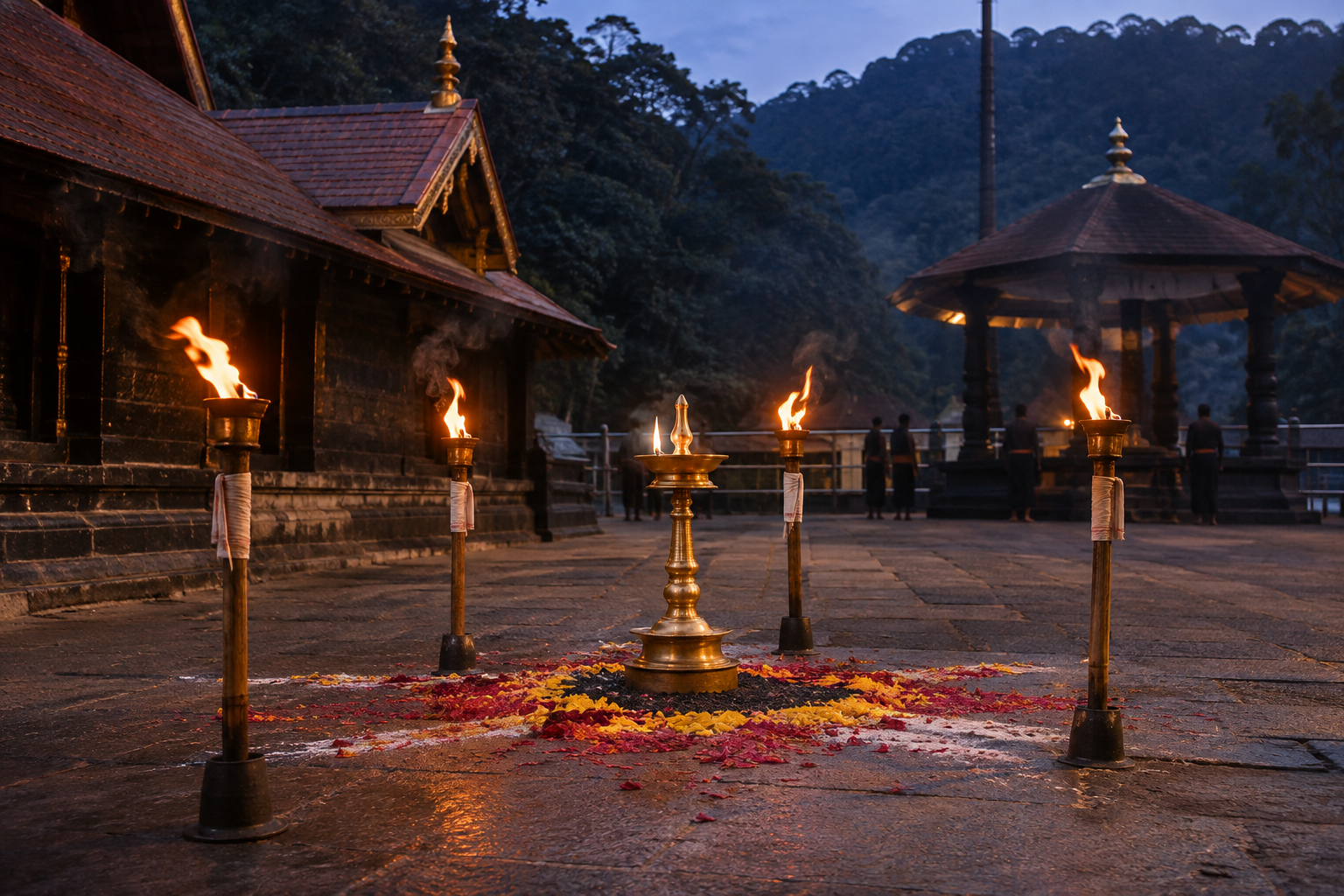
Guruthi is performed at the end of the Makaravilakku festival in the open area before Manimandapam, behind the Malikappuram shrine. In this context it is an offering for Bhadrakali and is connected with the protection and ordering of the sacred landscape.
The ritual includes Kalamezhuthu and song, five torches associated with the panchabhuta or five elements, nivedya and Guruthi Tarpanam. It is traditionally conducted by Kuruppans of the Kunnakad family from Ranni in the presence of a representative of the Pandalam royal family.
Some concluding observances are restricted. Visitors should not attempt to enter closed areas, photograph private rites or reconstruct them based on brief descriptions. Respect includes accepting the boundary between a public explanation and ritual knowledge held by its hereditary practitioners.
Manimandapam and Kalamezhuthu
Manimandapam is regarded in temple tradition as Ayyappa's original residence at Malikappuram. During the five days of Kalamezhuthu, natural five-colour powders are used to create sacred floor images representing stages from divine childhood to the fully adorned Shasta.
The Kunnakad Kuruppans prepare the kalam and perform the accompanying song. Kerala Tourism notes that the traditional powders come from Ranni Thottamankaavu and pass through Pandalam Palace before reaching Sabarimala. The route expresses continuity among hereditary ritual service, royal tradition and the hill shrine.
What the traditions teach
The stories surrounding Malikappurathamma bring several themes together:
- Transformation: the Mahishi narrative moves from opposition to liberation and sacred presence.
- Devotion: the Poonkodi tradition remembers love directed toward Ayyappa.
- Divine feminine power: Bhagavathi and Bhadrakali express protection, dignity and spiritual force.
- Relationship: Sabarimala is a network of shrines, families, routes and observances rather than an isolated sanctum.
- Respect for plurality: several traditions can coexist without erasing their differences.
This plurality complements Sabarimala's larger message. The inner identity contemplated in Tat Tvam Asi does not flatten sacred forms; it allows devotees to encounter unity through Ayyappa, Bhagavathi and the many relationships held within the pilgrimage.
Guidance for pilgrims
- Visit Malikappuram respectfully after the main darshan, following the current route.
- Use only designated counters and places for offerings.
- Do not touch shrine structures, lamps or ritual materials without instruction.
- Avoid photographing worshippers or restricted ceremonies.
- Do not repeat sensational versions of the legends as though they were the only tradition.
- Follow police, Devaswom and temple staff instructions during Makaravilakku crowds.
- Keep the precinct clean and avoid unnecessary plastic or discarded offerings.
Frequently asked questions
Is Malikappurathamma the same as Mahishi?
One major sacred legend connects her with Mahishi after transformation and liberation. Another oral tradition connects her with Poonkodi of Cheerappanchira. Temple worship identifies her above all as Bhagavathi.
Why is she called Malikappurathamma?
The name is traditionally linked to her residence in the mansion-like shrine or malika at Malikappuram.
Should every pilgrim visit Malikappuram?
Kerala Tourism states that devotees should pay respects to Malikappurathamma after worshipping Sri Dharma Shasta. Access should follow current temple routing and instructions.
What is Guruthi?
At Malikappuram, Guruthi is a concluding Makaravilakku observance for Bhadrakali involving hereditary ritual service, lamps, sacred colour work, song and offerings. Parts of the observance are restricted.
What is Manimandapam?
It is a sacred structure in the Malikappuram precinct regarded as Ayyappa's original residence and used for important Makaravilakku traditions including Kalamezhuthu.
Is Malikappurathamma worshipped as Meenakshi?
Kerala Tourism records that she is also worshipped as Madurai Meenakshi in connection with historical traditions of the Pandya dynasty.
The Goddess within the Sabarimala sacred landscape
Malikappurathamma reveals that the meaning of Sabarimala cannot be contained in one path or one story. Her shrine holds the presence of Bhagavathi; her legends remember transformation and devotion; and her festival traditions preserve the service of hereditary communities and the Pandalam royal connection.
To bow at Malikappuram is to recognize this larger sacred world. The pilgrimage to Ayyappa is completed not by ignoring its related presences, but by approaching each with humility, care and reverence. Swamiye Saranam Ayyappa.


