

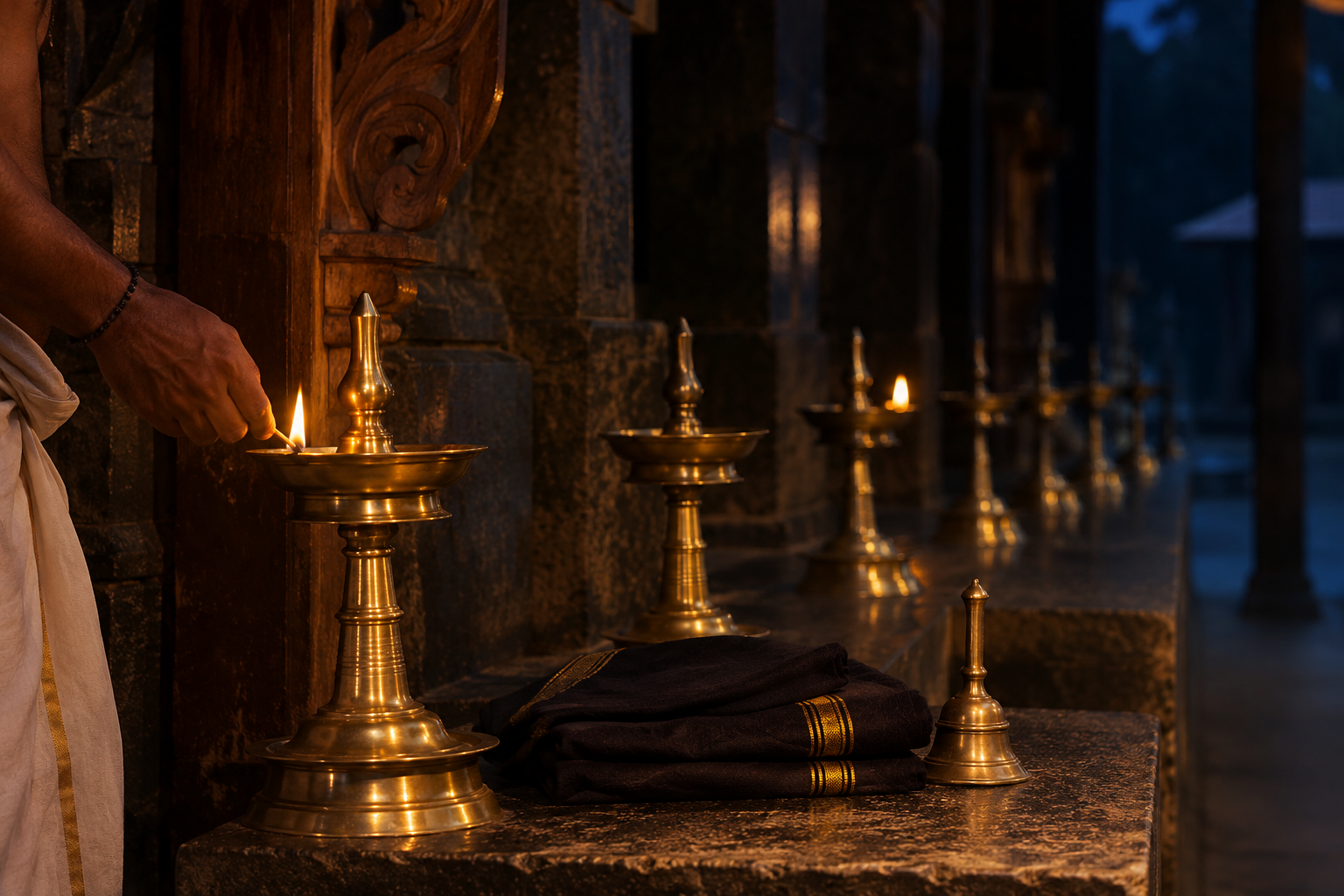
Harivarasanam is the devotional hymn associated with the closing of the Sabarimala temple for the night. As its gentle melody fills Sannidhanam, the day's movement gives way to stillness. Priests complete the final observances, the sacred lamps are attended to, and the sanctum is closed until the next opening.
It is often called the lullaby of Lord Ayyappa, or urakkupattu. Yet Harivarasanam is more than a soothing song. Its verses praise Ayyappa as the son of Hari and Hara, the embodiment of compassion, the destroyer of fear and the refuge of devotees. The nightly tradition turns those ideas into a shared moment of prayer.
When is Harivarasanam sung at Sabarimala?
Harivarasanam is heard after the final worship of the evening and immediately before the temple closes for the night. Kerala Tourism describes the junior priests leaving the sanctum area one by one as the hymn concludes. The melsanthi, or chief priest, then completes the closing actions and shuts the sanctum.
The Travancore Devaswom Board lists Harivarasanam as the last item in the daily pooja schedule, followed by temple closing. Timings can differ by season and operational requirements, so pilgrims should consult the current official schedule rather than treating any fixed hour as permanent.
What does the name Harivarasanam mean?
The opening name is commonly understood as describing the one seated in the noble or blessed posture associated with Hari. Across the hymn, Lord Ayyappa is addressed as Hariharatmaja—the son of Hari and Hara, Vishnu and Shiva. This identity is central to Sabarimala theology and presents Ayyappa as a meeting point of major devotional traditions.
The composition is structured as an ashtakam, a hymn of eight verses. Each verse builds a sequence of devotional names and attributes before returning to the seeker's refuge in Hariharatmaja. Rather than narrating the full story of Ayyappa, it contemplates who Ayyappa is and how the devotee approaches him.
The meaning of Harivarasanam
Without reproducing the full lyrics, the hymn's message can be understood through several recurring themes:
- Divine beauty: Ayyappa is contemplated through serene, auspicious and graceful imagery.
- Compassion: he is praised as one filled with mercy and responsive to sincere devotion.
- Protection: the hymn invokes the deity who overcomes hostility, fear and inner disturbance.
- Wisdom and dharma: Ayyappa is approached as a guide whose presence directs the seeker toward right conduct.
- Refuge: the repeated devotional movement is one of surrender to Hariharatmaja.
These themes explain why the hymn belongs so naturally at the end of the day. It does not create the excitement of a procession or festival. Instead, it gathers worship into quiet remembrance and entrusts the night to the divine.
Who wrote Harivarasanam?
The hymn is commonly credited to Kambangudi Kulathur Srinivasa Iyer, whose name appears in government and devotional accounts in several spelling variants. He is remembered as an Ayyappa devotee associated with the composition and its early recitation.
However, published accounts do not agree on every date, biographical detail or stage by which the hymn entered regular temple practice. Some sources describe Srinivasa Iyer as the author, while discussions of older printed material sometimes use terms such as compiler. A careful history should acknowledge this uncertainty instead of turning one later retelling into undisputed fact.
What is well established in living tradition is the hymn's place in Sabarimala's nightly closing and the deep affection devotees have for it.
The music and the voice known to millions
Harivarasanam is widely associated with the voice of K. J. Yesudas. His celebrated rendition, set in the contemplative Carnatic raga Madhyamavati and connected with G. Devarajan's music for the 1975 film Swami Ayyappan, carried the hymn far beyond Kerala. It became part of household prayer, pilgrimage vehicles, Ayyappa temples and devotional gatherings across languages and regions.
The recording's cultural reach should be distinguished from the text's authorship and from the precise history of temple practice. These are related but separate questions: one concerns the hymn, another its nightly ritual use, and another the recording through which many devotees first encountered it.
Is Harivarasanam a lullaby?
Calling it a lullaby communicates its gentle mood and its position at the close of the night. Devotees speak of Ayyappa being lovingly put to rest after the final pooja. In ritual terms, however, it is also a hymn of praise and refuge that accompanies the closing of the temple.
Both descriptions help. “Lullaby” conveys tenderness; “closing hymn” identifies its liturgical role. Reducing it to either a concert song or a bedtime melody misses the devotional setting that gives it meaning.
Why the closing ritual feels so powerful
Most of the Sabarimala pilgrimage is filled with movement: the vratham prepares the body and mind, groups travel together, pilgrims climb the hill, the sacred steps are crossed and offerings are made. Harivarasanam reverses that momentum. Movement becomes stillness, many voices become attentive silence, and the visible activity of worship recedes.
This transition gives the hymn unusual emotional force. The closing doors do not signify abandonment. They mark completion and trust—the worship of one day has ended, and devotion continues inwardly through the night.
Harivarasanam within the Sabarimala journey
The hymn is best understood alongside the practices that shape the pilgrimage. The discipline described in Sabarimala Mandalakalam and the 41-day vratham trains attention. The Irumudi Kettu gives that preparation a physical form. The ascent of Pathinettam Padi marks ritual readiness, and Neyyabhishekam turns the carried ghee into an offering.
Harivarasanam comes after such acts of striving and offering. Its mood is not “what must I do next?” but “where do I finally take refuge?” That inward turn also complements the non-dual reflection explored in Tat Tvam Asi at Sabarimala.
Listening with respect
For pilgrims present at Sannidhanam, Harivarasanam is part of a living temple observance rather than background entertainment. Respectful participation means allowing the closing ritual to unfold without loud conversation, intrusive photography or attempts to turn the moment into a performance.
- Follow the directions of temple and security personnel.
- Maintain silence and avoid obstructing the movement of priests or pilgrims.
- Do not use mobile phones where their use is restricted.
- Do not sing over, amplify or interrupt the official rendition.
- Check current closing times through official sources before planning a visit.
Harivarasanam beyond Sabarimala
Today the hymn is sung and played in Ayyappa temples and homes around the world. For members of the diaspora, its first notes can recall the forested hill, the call of “Swamiye Saranam Ayyappa,” and memories of pilgrimage. Its musical life has become much wider than the physical temple.
Yet Sabarimala remains the tradition's centre. Listening elsewhere can be an act of devotion, but it points back to the nightly closing at Sannidhanam and to the discipline, equality and surrender associated with the pilgrimage.
Frequently asked questions
Is Harivarasanam sung every night?
It forms part of the nightly closing when the Sabarimala temple is open. The temple itself opens only on designated days and pilgrimage seasons, so it should not be understood as a year-round public ceremony.
How many verses does Harivarasanam have?
The familiar composition is an ashtakam of eight verses. Some descriptions count the repeated lines or portions differently, which can create confusion about the number.
What language is Harivarasanam?
It is a Sanskrit devotional composition, transmitted and pronounced within Kerala's devotional culture. Its popularity extends across Malayalam, Tamil, Telugu, Kannada and other language communities.
Who is Hariharatmaja?
Hariharatmaja means the son of Hari and Hara—Vishnu and Shiva—and is a central name for Lord Ayyappa in the hymn.
Which raga is associated with the familiar rendition?
The widely known K. J. Yesudas rendition is associated with Madhyamavati, a Carnatic raga often valued for its serene and auspicious character.
Why are the full lyrics not reproduced here?
This article focuses on meaning, history and ritual context. Readers should use an authorized publication or recording for the complete text and musical rendition.
A hymn that ends the day, not devotion
Harivarasanam gives Sabarimala one of its most recognizable moments. The hill temple grows quiet, the final lamps soften, and praise becomes repose. The ritual closes the sanctum, but its message remains with the pilgrim: compassion, protection, dharma and refuge in Hariharatmaja.
That is why the hymn travels so powerfully beyond one place and one night. It gathers the outward pilgrimage into an inward act of surrender. Swamiye Saranam Ayyappa.


