

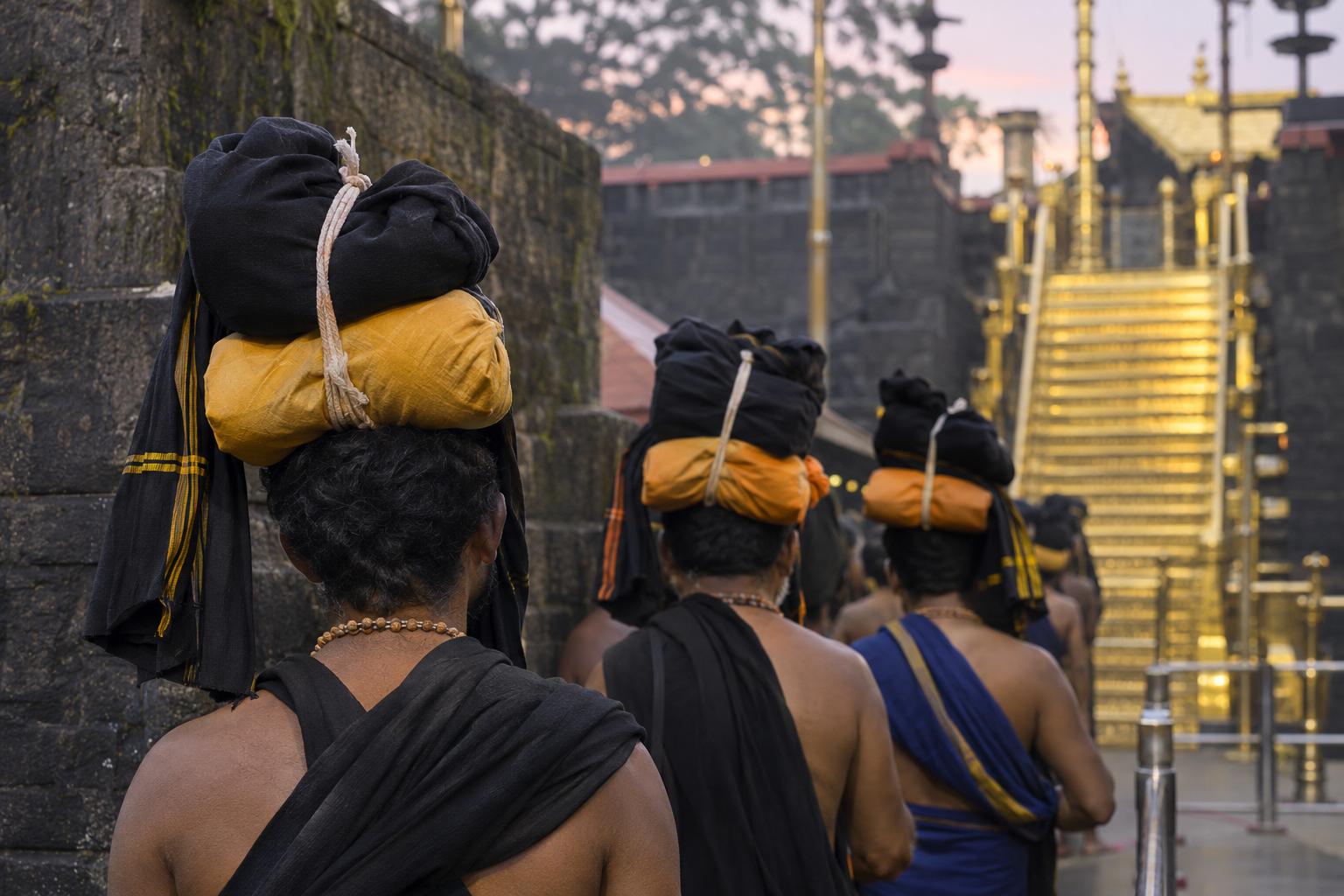
Pathinettam Padi, the eighteen sacred steps of Sabarimala, forms the principal ceremonial approach to the shrine of Lord Ayyappa. For a pilgrim who has completed the vratham and carries the irumudi, ascending these gold-clad steps is one of the journey’s most meaningful moments. The body climbs toward the sanctum while the symbolism asks the mind to rise beyond its habitual attachments.
The steps are not simply an architectural feature or a convenient entrance. They belong to a living ritual tradition shaped by devotion, temple discipline and several layers of interpretation. This article explains what the name means, why the number eighteen matters, how the irumudi is connected with the ascent and why different explanations should be approached with respect.
What does Pathinettam Padi mean?
In Malayalam, pathinettu means eighteen and padi means step. Pathinettam Padi therefore refers to the “eighteenth step” and, by established usage, to the entire flight of eighteen sacred steps at Sabarimala. Variants such as Pathinettampadi, Pathinettu Padi and Pathinettu Thripadikal are also commonly encountered.
The steps rise toward the Sannidhanam, the sacred presence of Lord Ayyappa. Kerala Tourism describes them as a distinctive feature of Sabarimala, each bearing religious significance. Tradition also remembers Lord Ayyappa asking his earthly father, the King of Pandalam, to build the temple with eighteen steps.
Why are there eighteen sacred steps?
There is no single explanation that exhausts the symbolism of eighteen. Temple tradition preserves several readings, and official cultural sources explicitly acknowledge that many versions exist. This variety is not a defect to be corrected. It shows how devotees and teachers have contemplated the ascent through different philosophical, bodily and scriptural frameworks.
The best-known interpretation groups the eighteen as:
- Five senses or panchendriyas — sight, hearing, smell, taste and touch.
- Eight passions or ashtaragas — commonly listed as desire, anger, greed, attachment, jealousy, vanity, pride and envy or rivalry.
- Three gunas — sattva, rajas and tamas, the three qualities used in Indian philosophical traditions to describe patterns of nature and mind.
- Vidya and avidya — knowledge and ignorance.
Five plus eight plus three plus two gives eighteen. In this reading, the ascent represents going beyond the domination of the senses and passions, understanding the play of the gunas, and finally surrendering both what one knows and what remains unknown.
This should not be reduced to a rigid claim that each physical step has one universally fixed label. It is better understood as a contemplative map of the whole ascent.
Other traditional interpretations of eighteen
Kerala Tourism records several other explanations. The number has been connected with five senses, six conditions and seven dhatus that constitute the body. Other traditions associate it with eighteen worlds, the eighteen Puranas, or eighteen weapons linked with Lord Ayyappa’s victory over evil. Another interpretation reads the ascent as transcending the created or material world.
These explanations work at different levels. Some focus on the human body, some on ethical discipline, some on cosmology and others on Ayyappa lore. Their common direction is more important than forcing them into one scheme: the pilgrim is invited to move from limitation toward clarity and surrender.
The eighteen steps and the Mandalakalam vratham
The sacred ascent begins long before the pilgrim reaches the staircase. It is prepared through the disciplines of the Ayyappa vratham—simple living, prayer, vegetarian food, restraint, truthfulness and service. The traditional 41-day observance trains the devotee to confront precisely the impulses symbolised by the steps.
Our guide to Sabarimala Mandalakalam and the 41-day Ayyappa vratham explains this preparation in detail. Read in that context, Pathinettam Padi is not a shortcut to holiness. It is the visible culmination of a discipline already practised in daily life.
Why is the irumudi required?
According to the official Kerala Sabarimala rituals portal, only devotees carrying the irumudi kettu on the head are permitted to climb the eighteen sacred steps. The irumudi is a two-compartment bundle prepared through the kettunirakkal ritual, normally under the guidance of a guruswami.
The front compartment contains offerings for Lord Ayyappa, including the ghee-filled coconut central to the pilgrimage tradition. The other compartment carries items used by the pilgrim. It is not ordinary baggage: carrying it expresses readiness, responsibility and the completion of prescribed preparation.
Visitors without an irumudi follow the currently designated alternative approach for darshan. Procedures can change with crowd management and temple administration, so pilgrims should follow the instructions of the Travancore Devaswom Board, police and officials on duty.
Ascending as an inner act
A staircase naturally suggests gradual movement. One does not leap from the ground to the sanctum; one rises step by step. The symbolism of Pathinettam Padi likewise avoids the idea of instant transformation. The devotee repeatedly practises restraint, repeatedly remembers Ayyappa and repeatedly places personal pride beneath a larger spiritual purpose.
The message resonates with Tat Tvam Asi at Sabarimala. The pilgrimage asks the seeker to recognise the sacred at the deepest level of the Self, while the eighteen steps dramatise the disciplines and surrender through which that recognition is approached.
What is Padi Pooja?
Padi Pooja is the ritual worship of the eighteen sacred steps. Kerala Tourism describes the steps being adorned with flowers, silk cloth and traditional lamps. The Tantri, or head priest, conducts the ceremony in the presence of the Melshanti, the chief priest, and concludes it with aarathi.
The ritual honours the steps themselves as part of the sacred complex. Its atmosphere of ordered lamps, offerings and prayer turns attention from the steps as metal-clad structures to the spiritual ascent they embody. Padi Pooja is performed on specified days rather than being assumed available at every temple opening.

Respectful conduct near the holy steps
Devotion must be joined with safety and consideration for others. Kerala Tourism’s current guidance includes several important instructions:
- Follow the designated queue and cooperate with police and Devaswom officials.
- Do not kneel on the sacred steps while climbing.
- Do not break coconuts on the steps; use only the place designated for that purpose.
- Avoid stopping for photographs or obstructing the flow of pilgrims.
- Do not attempt the climb in one exhausting effort if you need rest; use permitted resting points before entering constrained areas.
- Seek medical assistance early if breathlessness, chest discomfort, dizziness or unusual fatigue occurs.
Instructions issued for a particular season take precedence over general descriptions. Crowd routes, access arrangements and security procedures may be updated.
Frequently asked questions
What is the English meaning of Pathinettam Padi?
It is commonly translated as the eighteen sacred steps of Sabarimala. Literally, the expression centres on the “eighteenth step,” while customary usage names the entire staircase.
What do the eighteen steps represent?
The most popular reading groups them as five senses, eight passions, three gunas, and vidya and avidya. Other interpretations connect eighteen with bodily constituents, worlds, Puranas or weapons associated with Ayyappa. Multiple traditional explanations coexist.
Can everyone climb the eighteen steps?
Traditional access to Pathinettam Padi is for devotees who have observed the prescribed austerities and carry the properly prepared irumudi. Other visitors use the route designated by temple authorities.
Why are the steps covered in gold?
The sacred staircase is gold-clad as part of its honoured place in the temple complex. The covering protects and dignifies the ceremonial approach; its spiritual importance comes from the tradition and worship associated with it rather than the material alone.
Is Padi Pooja conducted every day?
No. It is a special ritual conducted on specified days. Devotees should consult current official temple information rather than assuming availability during every opening period.
Eighteen steps, one direction
Pathinettam Padi gathers the whole Sabarimala pilgrimage into a single image. The vratham disciplines the senses and habits; the irumudi carries offering and responsibility; the queue teaches patience and equality; and the steps direct every pilgrim toward Ayyappa.
The interpretations may be many, but their movement is shared. The ascent asks the devotee to become lighter—not by discarding responsibility, but by surrendering anger, greed, vanity and division. At the top, the pilgrim does not celebrate a personal conquest. The appropriate response remains the prayer carried throughout the journey: Swamiye Saranam Ayyappa.


