

Makara Vilakku and Makara Jyothi are closely associated with Sabarimala's great mid-January pilgrimage observance, but the two terms do not mean exactly the same thing. One refers to the festival and ceremonial lamp at Ponnambalamedu; the other refers, in the traditional distinction, to the celestial sign seen at Makara Sankrama.
Because both are witnessed on the same evening and are often described simply as “the light,” everyday speech and even some publications use the names interchangeably. A clear explanation can honour devotion while also stating what is astronomical and what is ritually performed by people.
The difference in brief
- Makara Jyothi: the celestial light or star associated with the sky at Makara Sankrama in Sabarimala tradition.
- Makara Vilakku: the ceremonial lamp or deepam lit at Ponnambalamedu, and by extension the major Sabarimala festival surrounding Makara Sankrama.
The star is a natural celestial appearance. The lamp on the hill is a human-lit ritual flame. The devotional importance of Makara Vilakku comes from its sacred timing, inherited tradition and relationship to Ayyappa worship—not from a claim that fire appears without human action.
What is Makara Sankrama?
Makara Sankrama marks the calendrical transition into the solar month of Makaram, usually observed in mid-January. Across India, the season is associated with Makara Sankranti and the sun's northward annual cycle in traditional calendrical understanding.
At Sabarimala, Makara Sankrama is the focal evening of the Makaravilakku pilgrimage season. The sacred ornaments reach Sannidhanam, Lord Ayyappa is adorned, deeparadhana is performed, the celestial sign is watched for and the ritual lamp is seen on the distant ridge.
What is Makara Jyothi?
Kerala Tourism's festival documentation distinguishes Makara Jyothi as the star that becomes visible in the sky during the Makara Sankrama worship. Devotees regard its appearance at this auspicious time as sacred.
The tradition does not require the star itself to be a supernatural object. Hindu pilgrimage frequently brings natural cycles—sunrise, lunar days, seasonal transitions, rivers, forests and stars—into sacred time. A celestial appearance can be astronomically natural and religiously meaningful at once.
It is best not to identify the light with a particular named star unless citing a reliable astronomical observation for a specific year and viewing location. Popular sources disagree on that detail, while the temple tradition is concerned primarily with its appearance at Makara Sankrama.
What is Makara Vilakku?
Vilakku means lamp in Malayalam. Makara Vilakku refers to the ceremonial deepam seen at Ponnambalamedu on Makara Sankrama and also to the wider festival cycle at Sabarimala. The flame on the ridge is ritually lit by people.
Kerala High Court records describe the Travancore Devaswom Board's role in conducting deeparadhana at Ponnambalamedu, with cooperation and protection from the Forest and Police Departments. This is therefore a performed religious observance, not an unexplained fire.
Saying that the lamp is human-lit does not make it spiritually empty. Temple lamps everywhere are lit by human hands. Their sacred meaning arises through consecrated purpose, prayer and tradition.
Why are the names often confused?
The confusion has several understandable causes. Both lights are associated with the same evening. Pilgrims look toward the sky and the Ponnambalamedu direction within a short ritual sequence. In Malayalam and other Indian languages, words such as jyothi, deepam and vilakku all evoke sacred light. News reports have also shifted between the expressions over time.
A useful way to remember the distinction is:
- Look upward for Jyothi: the celestial sign.
- Look toward the ridge for Vilakku: the ceremonial lamp.
- Use Makaravilakku for the festival: the larger observance extending beyond one moment of light.
The Thiruvabharanam procession
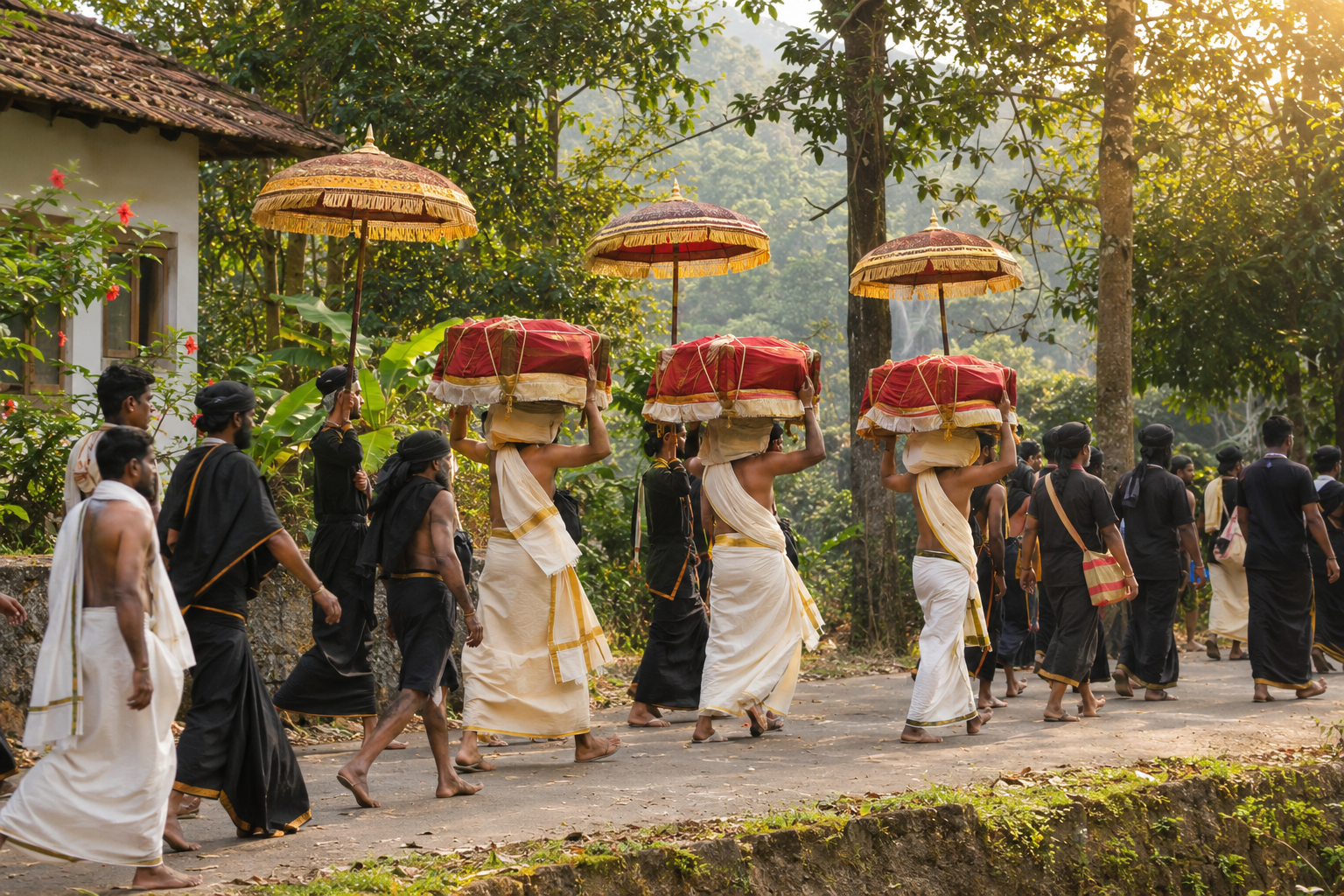
One of the most important events surrounding Makara Vilakku is the arrival of the Thiruvabharanam, the sacred gold ornaments used to adorn Lord Ayyappa. The ornaments are traditionally kept under the care of the Pandalam royal tradition and carried from the Valiya Koyikkal temple at Pandalam to Sabarimala.
Kerala Tourism describes three sacred chests and a journey of roughly three days. The main chest contains the ornaments; the others hold associated ceremonial objects. A representative of the Pandalam royal family accompanies the procession, which receives devotional welcomes along its route.
At Sannidhanam, the ornaments are placed on Lord Ayyappa before deeparadhana on Makara Vilakku evening. This arrival links Pandalam's memory of Ayyappa as Manikantan, the royal son, with worship of Dharma Shasta at Sabarimala.
Makara Vilakku is more than one evening
Kerala Tourism describes the Makaravilakku festival as extending across the first five days of Makaram. The observances include Kalamezhuthu Pattu, ceremonial processions, Nayattu Vili and the concluding Guruthi tradition.
For four days, processional observances move between Malikappuram and the sacred eighteen steps. On the fifth day, the procession reaches Sharamkuthi and returns in solemn silence. Guruthi at Malikappuram brings the festival cycle to its conclusion.
Our article on Malikappurathamma, Guruthi and Manimandapam explains these linked traditions. The public focus on the distant light can otherwise hide the festival's rich ritual sequence.
From Mandalakalam to Makaravilakku
Makaravilakku follows the Mandala pilgrimage period and forms the great second phase of the Sabarimala season. The disciplined preparation described in Sabarimala Mandalakalam and the 41-day vratham continues to shape pilgrims arriving for Makara Sankrama.
Traditional devotees carry the Irumudi Kettu, ascend Pathinettam Padi in accordance with temple custom and make offerings such as Neyyabhishekam. Makara Vilakku therefore belongs within a complete pilgrimage discipline, not merely a trip to view a distant flame.
The spiritual meaning of sacred light
Light in Hindu worship represents knowledge, presence, auspiciousness and the removal of darkness. At Makara Sankrama, celestial light and ritual lamp are contemplated together: nature provides the sky and seasonal turning; human beings respond with worship and flame.
This relationship avoids a false choice between faith and fact. The lamp has human attendants, yet it can still carry sacred meaning. The star follows natural order, yet devotees can experience its timing as spiritually significant. The ritual does not need confusion to remain profound.
The symbolism also complements Tat Tvam Asi at Sabarimala: the outer light directs attention toward awareness, knowledge and the divine presence sought within.
Crowd safety is part of pilgrimage dharma
Makara Vilakku attracts exceptionally large gatherings across steep forest terrain. Past crowd disasters, including the Pullumedu tragedy of 2011, show why accurate information and disciplined movement are essential. Devotion must never be used to justify unsafe viewing.
- Use only viewing zones and routes opened by the authorities.
- Do not enter forests, closed ridges or restricted Ponnambalamedu areas.
- Do not stand on unstable slopes, barriers, rooftops or tree branches.
- Follow police directions and allow crowds to disperse in stages.
- Keep children, older pilgrims and companions together.
- Carry essential medicines and use official medical facilities when needed.
- Check the current Virtual-Q, transport and access rules before travel.
- Never rush based on rumours that a sighting has begun or ended.
The distant lamp is visible from several traditionally used areas, but availability and access can change. Current government and Devaswom announcements should determine the plan for a particular year.
Frequently asked questions
Are Makara Jyothi and Makara Vilakku the same?
No. In the clear traditional distinction, Makara Jyothi is the celestial sign or star, while Makara Vilakku is the ritual lamp at Ponnambalamedu and the name of the festival.
Is the light at Ponnambalamedu man-made?
The Makara Vilakku deepam is ceremonially lit by people as a religious observance. Court records describe the institutional arrangements for conducting and protecting the ritual.
Does that mean Makara Vilakku is not sacred?
No. Human hands light temple lamps throughout Hindu worship. A lamp can be intentionally lit and still be sacred because of its ritual context and devotional meaning.
What is Thiruvabharanam?
Thiruvabharanam means the sacred ornaments of Lord Ayyappa. They are carried in ceremonial chests from Pandalam and placed on the deity before deeparadhana on Makara Vilakku evening.
When is Makara Vilakku observed?
It is associated with Makara Sankrama in mid-January. The exact civil date and operational schedule should be checked through official announcements each year.
Can pilgrims visit Ponnambalamedu?
Ponnambalamedu lies within a protected and restricted forest landscape. Pilgrims must not attempt unauthorized access and should use only officially designated viewing areas.
Faith strengthened by clarity
Makara Vilakku is one of Sabarimala's most powerful collective observances. Its meaning includes the sacred ornaments from Pandalam, Ayyappa's adornment, deeparadhana, celestial timing, the distant ritual flame and five days of traditions centred on Manimandapam, Sharamkuthi and Malikappuram.
Distinguishing Makara Jyothi from Makara Vilakku does not diminish that experience. It allows devotion to rest on clarity: a natural light in the sky, a ritual light kindled on the hill and the inward light of knowledge toward which both can point. Swamiye Saranam Ayyappa.


