

Pettathullal is the vibrant ritual dance performed by Ayyappa devotees at Erumeli during the Mandala–Makaravilakku pilgrimage season. Covered with holy ash, sandal and restrained colour, wearing leaves and carrying symbolic arrows and provision bundles, pilgrims dance through the town before beginning the demanding traditional route toward Sabarimala.
The ritual remembers victory, fellowship and the movement from Erumeli into Ayyappa's sacred forest. Its present ceremonial route includes several established stops, but accounts disagree about the identity and origin of one associated guardian: official sources call him Vavar, while a separate Sastha ritual tradition names Vapuran. The difference deserves to be stated rather than hidden.
What does Pettathullal mean?
Petta refers to the locality or settlement associated with the ritual at Erumeli, while thullal conveys energetic dancing or leaping. Pettathullal is not a classical stage performance. It is a collective pilgrimage action in which movement, chanting, costume and route carry meaning together.
The official Sabarimala portal describes it as a sacred dance that commemorates Ayyappa's hunt and victory over Mahishi. Some later narratives also connect the dance with a military victory involving an associate called Vavar. That second account belongs to a debated stream of the tradition and should not be presented as settled history.
The Mahishi legend
In the best-known sacred narrative, Ayyappa is born as Hariharatmaja—the son of Shiva and Vishnu in the form of Mohini—to overcome Mahishi. Pettathullal celebrates the defeat of the force she represents and the restoration of order.
The energetic dance expresses the joy of victory. Ash and colour, leaf dress, wooden arrows and forest imagery move the story out of a book and into the pilgrim's body. The devotee does not impersonate Ayyappa as an actor; the group remembers and celebrates the sacred event through shared movement.
The later transformation of Mahishi is connected with traditions surrounding Malikappurathamma at Sabarimala. Reading the stories together shows how victory is followed by liberation and a new sacred relationship.
Vavar and Vapuran: two different claims
Government of Kerala and Kerala Tourism sources describe Vavar as a Muslim saint, warrior or companion of Ayyappa. In the current Erumeli observance, the Ambalappuzha procession stops at Vavar Palli and is formally received by representatives of the Erumeli Mahallu Jamaat before continuing to the Dharma Sastha temple.
A different ritual-text tradition identifies Vapuran as a Shiva-bhuta, guardian and parivara devata of Sastha. Advocates of this interpretation cite Yogi Baladandayudhapani Swamikal's Sri Maha Shasthu Pooja Kalpam, dated to Kollam Era 1114 (1938–39), including a mantra addressed to Vapuran as a guardian of Maha Sastha's retinue.
These names should not be silently treated as interchangeable. The 1938 manual is evidence that a Vapuran guardian tradition exists; it does not by itself prove when the Erumeli Vavar tradition began or establish that the entire public ritual was deliberately fabricated. Conversely, present official usage cannot erase the distinct Vapuran material. The historically responsible conclusion is that the sources preserve competing identifications.
Why Erumeli is important
Erumeli is the gateway to the traditional forest pilgrimage route. The town's present ceremonial geography includes the Kochambalam or smaller Dharma Sastha temple, the site officially called Vavar Palli and the Valiyambalam or larger Dharma Sastha temple.
Pilgrims offer worship at the associated shrines before proceeding toward Perur Thodu and the forest. Erumeli is therefore more than a transport stop. It is where the disciplined devotee enters the landscape of Ayyappa's story and accepts the collective identity of the pilgrimage.
What do participants wear and carry?
Kerala Tourism describes Pettathullal participants using sandal powder and ash on the body, leaves of the orange-berry plant, leaf crowns, arrows and a small bundle of vegetables suspended from a stick over the shoulder. Current practice may vary between organized ceremonial groups and other pilgrimage parties.
Each element evokes the forest campaign:
- Ash and sandal: mark the body as part of ritual rather than ordinary display.
- Leaves and leaf crowns: connect the group with the forest setting of the sacred story.
- Wooden arrows: recall the hunt and victory while remaining symbolic objects.
- Vegetable bundles: evoke provisions carried by a travelling group through difficult terrain.
- Black or dark clothing: connects the dancers with the wider Ayyappa vrata and pilgrimage discipline.
These should not become excuses for litter, aggressive behaviour or unsafe weapons. Participants must follow current police, temple and organizing-group requirements.
The Ambalappuzha and Alangad groups
The most prominent ceremonial Pettathullal occurs on the 27th day of the Malayalam month of Dhanu. The Government of Kerala's Sabarimala portal describes the Ambalappuzha group beginning first around noon after the traditional sighting of a kite in the sky.
The group dances from the Kochambalam toward Vavar Palli, where Mahallu Jamaat representatives receive the pilgrims. They then accompany the procession to the Valiyambalam, where Travancore Devaswom Board officials receive them.
The Alangad group's ceremonial dance begins later in the afternoon, traditionally after a daylight star sighting. Accounts of the two groups preserve distinct customs; they should not be treated as interchangeable copies of one event.
The present Erumeli route
Whatever conclusion a devotee reaches about Vavar and Vapuran, the current official Pettathullal route is a verifiable public fact. Government sources record the ceremonial stop at Vavar Palli, reception by Mahallu Jamaat representatives and onward movement to Valiyambalam. Describing that current practice is different from claiming that every story told about its origin is historically proven.
Pilgrims should follow the route administered for the event without being compelled to adopt one historical interpretation. Sacred tradition, public custom and textual history can overlap without being identical.
From dance to the traditional forest route
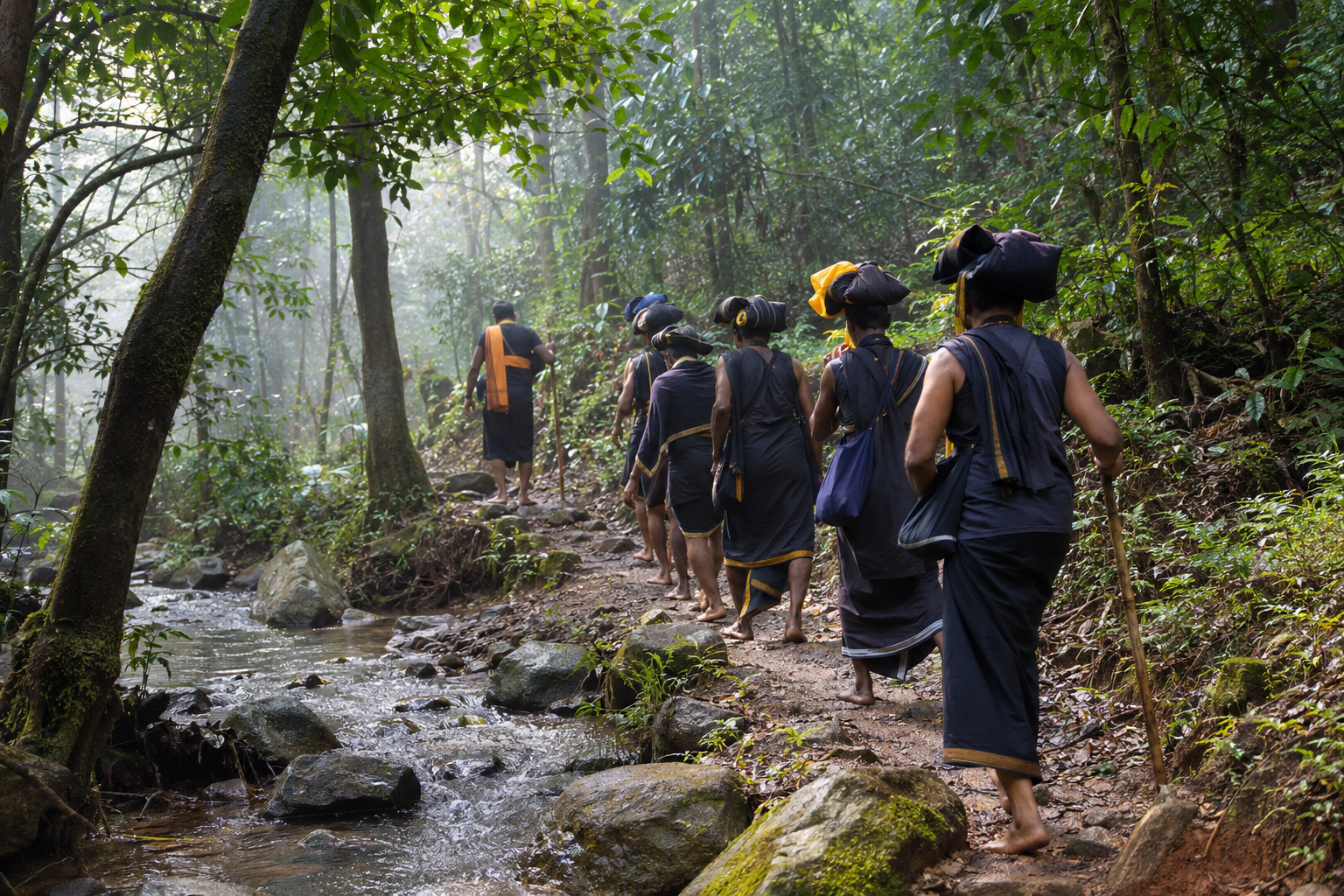
After the Erumeli observances, pilgrims begin the ancient path toward Sannidhanam. The official route passes through Perur Thodu, Kaalaketti, Azhutha, Inchipparakota, Karimala and Pampa before the final climb.
This is a strenuous forest and hill journey, not a symbolic stroll. Access rules, route openings and safety arrangements can change. Pilgrims should travel with experienced groups, carry necessary medicines, obey forest restrictions and never assume that an older route description guarantees present access.
The dance at Erumeli transforms into endurance on the trail. The same collective energy that animates Pettathullal becomes mutual support across steep climbs, river crossings and long distances.
Pettathullal and Kanni Ayyappans
First-time Sabarimala pilgrims are known as Kanni Ayyappans. They have a special place in group traditions and often participate under the close guidance of a guruswami. Symbolic arrows carried from Erumeli are associated with Sharamkuthi, where first-time pilgrims traditionally leave them according to local custom.
The first pilgrimage is not a license to imitate isolated images from social media. Clothing, objects, chanting and movement should be learned from the guruswami and the organized group. The preparation begins much earlier through the 41-day Mandala vratham and the ceremonial packing of the Irumudi Kettu.
Connection with Makara Vilakku
The major Ambalappuzha and Alangad observances belong to the closing phase of the annual pilgrimage season. After Erumeli and the traditional trek, the groups reach Pampa and continue toward Sannidhanam for the Makara Vilakku festival.
This places Pettathullal within a larger sequence: vrata, Erumeli worship, ritual dance, forest journey, Pampa, the sacred ascent and worship of Ayyappa. Removing it from that sequence turns a pilgrimage ritual into a colourful spectacle and misses its spiritual purpose.
How to participate respectfully
- Participate under an experienced guruswami or recognized pilgrimage group.
- Follow the route and timing directed by police, Devaswom and local organizers.
- Use only safe symbolic arrows and sticks permitted by the authorities.
- Keep ash, colour and plant materials restrained and environmentally responsible.
- Do not force colour onto bystanders, damage property or block emergency movement.
- At every established stop, follow the directions of the site's lawful custodians and event authorities.
- Ask permission before photographing worshippers or community members.
- Do not leave leaves, plastic, paint containers or food waste on the street or forest route.
- Remain hydrated and seek medical help if the dancing or trek causes distress.
Frequently asked questions
Is Pettathullal performed only on one day?
Pilgrimage groups may perform forms of the ritual during the Dhanu season, while the major ceremonial observances of the Ambalappuzha and Alangad groups occur on the 27th of Dhanu.
Is the associated guardian Vavar or Vapuran?
Official Sabarimala sources and the present Erumeli route use Vavar and identify him as a Muslim saint or companion. A distinct Sastha ritual manual from 1938–39 identifies Vapuran as a Shiva-bhuta and guardian deity. Available evidence documents both claims but does not justify presenting either debated origin story as uncontested history.
Who performs first, Ambalappuzha or Alangad?
The Ambalappuzha group traditionally begins around noon. The Alangad group follows in the afternoon, with each preserving its own customary sign and sequence.
Is Pettathullal a folk dance show?
No. It uses folk movement, costume and percussion, but its primary identity is a pilgrimage ritual tied to Ayyappa's legends and the Erumeli route.
Can visitors watch without participating?
Yes, subject to crowd-control arrangements. Spectators should remain in permitted areas, avoid obstructing the procession and treat participants and sacred sites respectfully.
Does every Sabarimala pilgrim take the Erumeli forest route?
No. Several routes and transport arrangements exist. The Erumeli path is the traditional and physically demanding route, and access should be confirmed for the intended season.
Victory expressed through disciplined pilgrimage
Pettathullal remembers Ayyappa's victory, but its deepest public lesson is collective. Devotees dance as a group, complete the established Erumeli observances and then face the forest journey together.
The ritual turns triumph away from individual pride. Victory becomes gratitude, disciplined energy and mutual support. From Erumeli's streets to Sabarimala's sacred steps, its movement is toward refuge in Ayyappa. Swamiye Saranam Ayyappa.


